Milton Friedman explodes the myth that the Great Depression was produced by a failure of private enterprise.
keskiviikko 9. tammikuuta 2013
Milton Friedman - The Great Depression Myth
Milton Friedman explodes the myth that the Great Depression was produced by a failure of private enterprise.

maanantai 17. joulukuuta 2012
The Virtue of Selfishness - Ayn Rand

http://www.filesbowl.com/5Gh/The-Virtue-Of-Selfishness-A-New-Concept-Of-Egoism.mobi
Ayn Rand here sets forth the moral principles of Objectivism, the philosophy that holds man's life--the life proper to a rational being--as the standard of moral values and regards altruism as incompatible with man's nature, with the creative requirements of his survival, and with a free society.
keskiviikko 12. joulukuuta 2012
Thomas Paine's Rights of Man: A Biography

https://www.rapidshare.com/files/3515613462/Christopher.Hitchens-Thomas.Paines.Rights.of.Man.rar
Thomas Paine's critique of monarchy and introduction of the concept of human rights influenced both the French and the American revolutions, argues Vanity Fair contributor and bestselling author Hitchens (God Is Not Great) in this incisive addition to the Books That Changed the World series. Paine's ideas even influenced later independence movements among the Irish, Scots and Welsh. In this lucid assessment, Hitchens notes that in addition to Common Sense's influence on Jefferson and the Declaration of Independence, Paine wrote in unadorned prose that ordinary people could understand. Hitchens reads Paine's rejection of the ministrations of clergy in his dying moments as an instance of his unyielding commitment to the cause of rights and reason. But Hitchens also takes Paine to task for appealing to an idealized state of nature, a rhetorical move that, Hitchens charges, posits either a mythical past or an unattainable future and, Hitchens avers, disordered the radical tradition thereafter. Hitchens writes in characteristically energetic prose, and his aversion to religion is in evidence, too. Young Paine found his mother's Anglican orthodoxy noxious, Hitchens notes: Freethinking has good reason to be grateful to Mrs Paine.
sunnuntai 9. joulukuuta 2012
Bitcoin for Dummies
The last addition to our archives was Denationalisation of Money by Murray Rothbard. This blog post is about how that denationalisation might be closer to happen than you think. The reason is Bitcoin. Cryptocurrency that no central bank can control.

http://www.technologyreview.com/news/424091/what-bitcoin-is-and-why-it-matters/
What do you think about Bitcoins? My two cents are that in addition to its many other great libertarian potentials everyone should consider it as tool to store value, because right now politicians are printing more of your friendly neighbourhood fiat-money in order to tax your savings away.
perjantai 7. joulukuuta 2012
Denationalisation of Money: The Argument Refined - Friedrich A. Hayek

http://library.mises.org/books/Friedrich%20A%20Hayek/Denationalisation%20of%20Money%20The%20Argument%20Refined.pdf
What if the government let anyone use a currency of his or her choosing? What if the government permitted entrepreneurs to innovate in the monetary sector, such as by creating digital currencies or minting commodity money?
This is precisely what F.A. Hayek argues.
By special arrangement with the Institute for Economic Affairs, the Mises Institute is pleased to offer a new printing of F.A. Hayek's most radical case for the complete privatization of money: The Denationalisation of Money. He wrote this near the end of his career, after thinking through all the economic arguments for monetary reform and examining the political viability of various proposals. He shows the essential unviability of government money, and calls for a complete free market in the production and distribution and management of money.
This book is the very core of the Hayekian approach to monetary policy, and the book that drew the world's attention to this radical thinker following his Nobel Prize in economics. The argument is substantively similar to Mises's but rather than a gold standard, Hayek argues for completely abandoning government attempts to reform money. The result would be competitive private currencies that permits the market alone to choose the dominant currency the world over.
In the digital age, his argument takes on new significance, as experimentation in digital currencies continues apace.
torstai 29. marraskuuta 2012
maanantai 19. marraskuuta 2012
Milton Friedman - Why Drugs Should Be Legalized
Milton Friedman eloquently presents why Colorado and Washington made the right choice. No victim. No crime.
maanantai 12. marraskuuta 2012
Human Action: Ludvig Von Mises
Human Action is widely considered Mises' Magnun Opus and it's easy to see why. This book makes truly a case for capitalism.
Human Action is probably the most important book on political economy you will ever own. It was (and remains) the most comprehensive, systematic, forthright, and powerful defense of the economics of liberty ever written.

Read the book
In the foreword to Human Action: A Treatise on Economics, Mises explains complex market phenomena as "the outcomes of countless conscious, purposive actions, choices, and preferences of individuals, each of whom was trying as best as he or she could under the circumstances to attain various wants and ends and to avoid undesired consequences." It is individual choices in response to personal subjective value judgments that ultimately determine market phenomena—supply and demand, prices, the pattern of production, and even profits and losses. Although governments may presume to set "prices," it is individuals who, by their actions and choices through competitive bidding for money, products, and services, actually determine "prices". Thus, Mises presents economics—not as a study of material goods, services, and products—but as a study of human actions. He sees the science of human action, praxeology, as a science of reason and logic, which recognizes a regularity in the sequence and interrelationships among market phenomena. Mises defends the methodology of praxeology against the criticisms of Marxists, socialists, positivists, and mathematical statisticians.
Mises attributes the tremendous technological progress and the consequent increase in wealth and general welfare in the last two centuries to the introduction of liberal government policies based on free-market economic teachings, creating an economic and political environment which permits individuals to pursue their respective goals in freedom and peace. Mises also explains the futility and counter-productiveness of government attempts to regulate, control, and equalize all people's circumstances: "Men are born unequal and ... it is precisely their inequality that generates social cooperation and civilization."
Ludwig von Mises (1881–1973) was the leading spokesman of the Austrian School of Economics throughout most of the twentieth century. He earned his doctorate in law and economics from the University of Vienna in 1906. In 1926, Mises founded the Austrian Institute for Business Cycle Research. From 1909 to 1934, he was an economist for the Vienna Chamber of Commerce. Before the Anschluss, in 1934 Mises left for Geneva, where he was a professor at the Graduate Institute of International Studies until 1940, when he emigrated to New York City. From 1948 to 1969, he was a visiting professor at New York University.
perjantai 2. marraskuuta 2012
Economics in One Lesson - Henry Hazlitt
This book is a truly economics 101. It is an eloquent little book and It`s very hard to name a better introduction for someone who wants to learn about economics and free market capitalism.

Read book
A million copy seller, Henry Hazlitt’s Economics in One Lesson is a classic economic primer. But it is also much more, having become a fundamental influence on modern “libertarian” economics of the type espoused by Ron Paul and others.
Considered among the leading economic thinkers of the “Austrian School,” which includes Carl Menger, Ludwig von Mises, Friedrich (F.A.) Hayek, and others, Henry Hazlitt (1894-1993), was a libertarian philosopher, an economist, and a journalist. He was the founding vice-president of the Foundation for Economic Education and an early editor of The Freeman magazine, an influential libertarian publication. Hazlitt wrote Economics in One Lesson, his seminal work, in 1946. Concise and instructive, it is also deceptively prescient and far-reaching in its efforts to dissemble economic fallacies that are so prevalent they have almost become a new orthodoxy.
Many current economic commentators across the political spectrum have credited Hazlitt with foreseeing the collapse of the global economy which occurred more than 50 years after the initial publication of Economics in One Lesson. Hazlitt’s focus on non-governmental solutions, strong — and strongly reasoned — anti-deficit position, and general emphasis on free markets, economic liberty of individuals, and the dangers of government intervention make Economics in One Lesson, every bit as relevant and valuable today as it has been since publication.
tiistai 30. lokakuuta 2012
What Has Government Done to Our Money? - Murray Rothbard
This is truly a book that every politician should have read. And unfortunately, most of them haven't.

Download the book
The book made huge theoretical advances. He was the first to prove that the government, and only the government, can destroy money on a mass scale, and he showed exactly how they go about this dirty deed. But just as importantly, it is beautifully written. He tells a thrilling story because he loves the subject so much.
The passion that Murray feels for the topic comes through in the prose and transfers to the reader. Readers become excited about the subject, and tell others. Students tell professors. Some, like the great Ron Paul of Texas, have even run for political office after having read it.
Rothbard shows precisely how banks create money out of thin air and how the central bank, backed by government power, allows them to get away with it. He shows how exchange rates and interest rates would work in a true free market. When it comes to describing the end of the gold standard, he is not content to describe the big trends. He names names and ferrets out all the interest groups involved.
Since Rothbard's death, scholars have worked to assess his legacy, and many of them agree that this little book is one of his most important. Though it has sometimes been inauspiciously packaged and is surprisingly short, its argument took huge strides toward explaining that it is impossible to understand public affairs in our time without understanding money and its destruction.
sunnuntai 28. lokakuuta 2012
Ayn Rand - Liberty vs Socialism
In this little video clip Ayn Rand explains how liberty and capitalism are fundamentally inseparable. If you still haven't read Atlas Shrugged I truly encourage you to download the ebook from my previous post.
perjantai 26. lokakuuta 2012
Atlas Shrugged - Ayn Rand
Who is John Galt?

Ayn Rand`s Atlas Shrugged is first work of fiction in our archives and that`s for a reason. This magnum opus is something that everyone should have read.
http://extabit.com/file/28y4e6wioz2f0
This is the story of a man who said that he would stop the motor of the world—and did. Was he a destroyer or the greatest of liberators? Why did he have to fight his battle, not against his enemies, but against those who needed him most, and his hardest battle against the woman he loved? What is the world’s motor—and the motive power of every man? You will know the answer to these questions when you discover the reason behind the baffling events that play havoc with the lives of the characters in this story.
Tremendous in its scope, this novel presents an astounding panorama of human life—from the productive genius who becomes a worthless playboy—to the great steel industrialist who does not know that he is working for his own destruction—to the philosopher who becomes a pirate—to the composer who gives up his career on the night of his triumph—to the woman who runs a transcontinental railroad—to the lowest track worker in her Terminal tunnels.
You must be prepared, when you read this novel, to check every premise at the root of your convictions. This is a mystery story, not about the murder—and rebirth—of man’s spirit. It is a philosophical revolution, told in the form of an action thriller of violent events, a ruthlessly brilliant plot structure and an irresistible suspense. Do you say this is impossible? Well, that is the first of your premises to check.
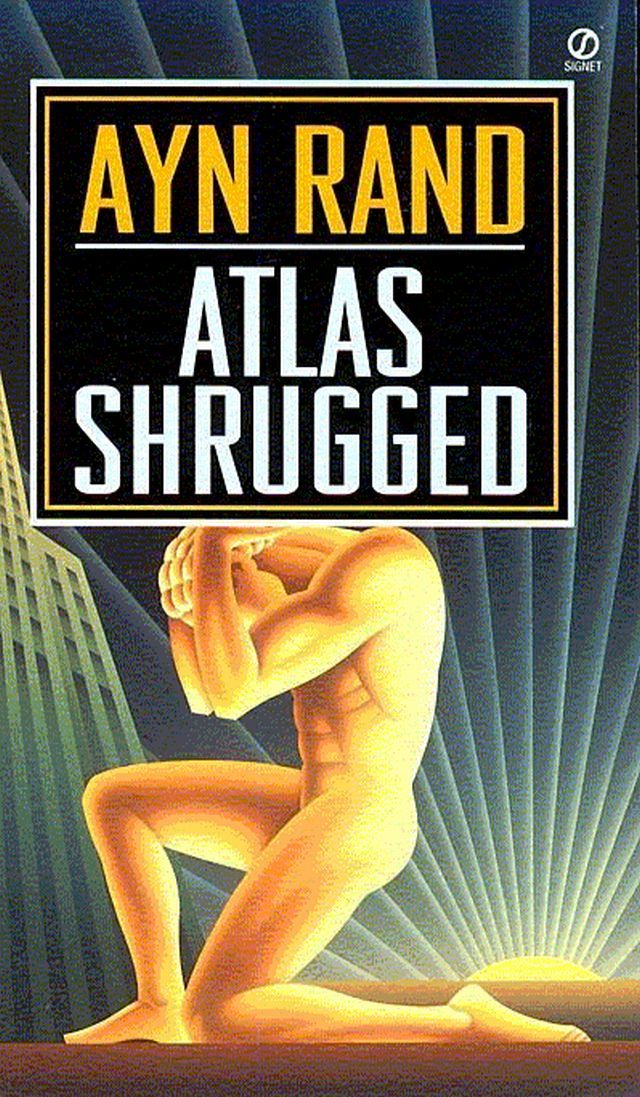
Ayn Rand`s Atlas Shrugged is first work of fiction in our archives and that`s for a reason. This magnum opus is something that everyone should have read.
http://extabit.com/file/28y4e6wioz2f0
This is the story of a man who said that he would stop the motor of the world—and did. Was he a destroyer or the greatest of liberators? Why did he have to fight his battle, not against his enemies, but against those who needed him most, and his hardest battle against the woman he loved? What is the world’s motor—and the motive power of every man? You will know the answer to these questions when you discover the reason behind the baffling events that play havoc with the lives of the characters in this story.
Tremendous in its scope, this novel presents an astounding panorama of human life—from the productive genius who becomes a worthless playboy—to the great steel industrialist who does not know that he is working for his own destruction—to the philosopher who becomes a pirate—to the composer who gives up his career on the night of his triumph—to the woman who runs a transcontinental railroad—to the lowest track worker in her Terminal tunnels.
You must be prepared, when you read this novel, to check every premise at the root of your convictions. This is a mystery story, not about the murder—and rebirth—of man’s spirit. It is a philosophical revolution, told in the form of an action thriller of violent events, a ruthlessly brilliant plot structure and an irresistible suspense. Do you say this is impossible? Well, that is the first of your premises to check.
torstai 25. lokakuuta 2012
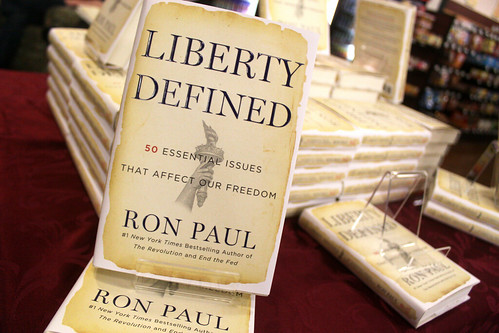
Liberty Defined: 50 Essential Issues That Affect Our Freedom - Ron Paul
And now again something little more modern. In this book Ron Paul defines what freedom is and how to get there. A truly must read for anyone interested in modern libertarianism.

http://rapidshareb.com/downloads/24/32/Liberty_Defined_50_Essential_Issues_That_Affect_Our_Freedom_-_
In Liberty Defined, congressman and #1 New York Times bestselling author Ron Paul returns with his most provocative, comprehensive, and compelling arguments for personal freedom to date. The term “Liberty” is so commonly used in our country that it has become a mere cliché. But do we know what it means? What it promises? How it factors into our daily lives? And most importantly, can we recognize tyranny when it is sold to us disguised as a form of liberty? Dr. Paul writes that to believe in liberty is not to believe in any particular social and economic outcome. It is to trust in the spontaneous order that emerges when the state does not intervene in human volition and human cooperation. It permits people to work out their problems for themselves, build lives for themselves, take risks and accept responsibility for the results, and make their own decisions. It is the seed of America. This is a comprehensive guide to Dr. Paul’s position on fifty of the most important issues of our times, from Abortion to Zionism. Accessible, easy to digest, and fearless in its discussion of controversial topics, LIBERTY DEFINED sheds new light on a word that is losing its shape.
http://rapidshareb.com/downloads/24/32/Liberty_Defined_50_Essential_Issues_That_Affect_Our_Freedom_-_
In Liberty Defined, congressman and #1 New York Times bestselling author Ron Paul returns with his most provocative, comprehensive, and compelling arguments for personal freedom to date. The term “Liberty” is so commonly used in our country that it has become a mere cliché. But do we know what it means? What it promises? How it factors into our daily lives? And most importantly, can we recognize tyranny when it is sold to us disguised as a form of liberty? Dr. Paul writes that to believe in liberty is not to believe in any particular social and economic outcome. It is to trust in the spontaneous order that emerges when the state does not intervene in human volition and human cooperation. It permits people to work out their problems for themselves, build lives for themselves, take risks and accept responsibility for the results, and make their own decisions. It is the seed of America. This is a comprehensive guide to Dr. Paul’s position on fifty of the most important issues of our times, from Abortion to Zionism. Accessible, easy to digest, and fearless in its discussion of controversial topics, LIBERTY DEFINED sheds new light on a word that is losing its shape.
keskiviikko 24. lokakuuta 2012
Hayek on Moral Values & Altruism
Check out this nice little video of FA Hayek. It won't take long, but it will give you a lot. Hayek shows there how morality has never come from Governments but how morality can only come from individuals. There is no such thing as a collective brain.
Friedrick Hayek - Road To Serfdom
Next intellectual hero on our archives is Friedrich Hayek. He`s eloquent book Road To Serfdom is draws a troubling picture and its timeless message is really serious when compared to the happenings all around us.

http://www.iea.org.uk/sites/default/files/publications/files/upldbook351pdf.pdf

http://www.iea.org.uk/sites/default/files/publications/files/upldbook351pdf.pdf
This spell-binding book is a classic in the history of liberal ideas. It was singularly responsible for launching an important debate on the relationship between political and economic freedom. It made the author a world-famous intellectual. It set a new standard for what it means to be a dissident intellectual. It warned of a new form of despotism enacted in the name of liberation. And though it appeared in 1944, it continues to have a remarkable impact. No one can consider himself well-schooled in modern political ideas without having absorbed its lessons.
What F.A. Hayek saw, and what most all his contemporaries missed, was that every step away from the free market and toward government planning represented a compromise of human freedom generally and a step toward a form of dictatorship--and this is true in all times and places. He demonstrated this against every claim that government control was really only a means of increasing social well-being. Hayek said that government planning would make society less liveable, more brutal, more despotic. Socialism in all its forms is contrary to freedom.
Nazism, he wrote, is not different in kind from Communism. Further, he showed that the very forms of government that England and America were supposedly fighting abroad were being enacted at home, if under a different guise. Further steps down this road, he said, can only end in the abolition of effective liberty for everyone.
Capitalism, he wrote, is the only system of economics compatible with human dignity, prosperity, and liberty. To the extent we move away from that system, we empower the worst people in society to manage what they do not understand.
The beauty of this book is not only in its analytics but in its style, which is unrelenting and passionate. Even today, the book remains a source of controversy. Socialists who imagine themselves to be against dictatorship cannot abide his argument, and they never stop attempting to refute it.
Misesians might find themselves disappointed that Hayek did not go far enough, and made too many compromises in the course of his argument. Even so, anyone who loves liberty cannot but feel a sense of gratitude that this book exists and remains an important part of the debate today.
Free To Choose - Milton Friedman (Book)
And now the book of same name. This book has been eye-opener for many and it`s a really pleasurable read.

The international bestseller on the extent to which personal freedom has been eroded by government regulations and agencies while personal prosperity has been undermined by government spending and economic controls.
http://rapidshare.com/files/176887794/_economics__Friedman__Milton___Rose_-_Free_To_Choose_--_A_Personal_Statement__1980_.pdf
Free To Choose - Milton Friedman (TV-series)
Little more from Milton Friedman. This TV-serie is real treasure for all libertarians.

Free To Choose® began as an award winning PBS television series featuring Milton Friedman, Nobel Prize-winning economist. Free To Choose was also a book written by Milton and Rose Friedman and published by Harcourt Brace Jovanovich. It was the best selling non-fiction book of 1980. The book and TV series have been translated into over 2 dozen languages.
Free To Choose is about freedom, the interrelationship of personal, political and economic freedom. Free To Choose is about the ideas of Milton and Rose Friedman, ideas that still dominate public policy debates decades after they were first proposed. Free To Choose is about those who refined and continue to extend these ideas.
Volume 1 - The Power of the Market
Dr. Friedman states, "There is not a single person in the world who can make this pencil." He explains that the creation of even a simple object - like the "lead" pencil - requires the knowledge of many people, lumberjacks, steel manufacturers, miners, etc. These people may not speak the same language, they may not know or like one another, yet the market enables them to combine knowledge and effort to produce wealth.
Volume 2 - The Tyranny of Control (1980)
Government planning and detailed control of economic activity lessens productive innovation, and consumer choice. Good, better, best, are replaced by "approved" or "authorized." Friedman shows how "established" industries or methods, seek government protection or subsidization in their attempts to stop or limit product improvements which they don’t control. Friedman visits India, Japan and U.S.
Volume 3 - Anatomy of a Crisis
What Caused the Great Depression, and What To Do About It
The Great Depression has been popularly viewed as a failure of capitalism. The stock market crash, the failure of the Bank of the United States, loss of personal savings, were visible symbols supporting this belief. As Friedman explains, the real cause was the unseen failure of government policy and action. Yet this crisis resulting from government failure leads to decades of government expansion.

Free To Choose® began as an award winning PBS television series featuring Milton Friedman, Nobel Prize-winning economist. Free To Choose was also a book written by Milton and Rose Friedman and published by Harcourt Brace Jovanovich. It was the best selling non-fiction book of 1980. The book and TV series have been translated into over 2 dozen languages.
Free To Choose is about freedom, the interrelationship of personal, political and economic freedom. Free To Choose is about the ideas of Milton and Rose Friedman, ideas that still dominate public policy debates decades after they were first proposed. Free To Choose is about those who refined and continue to extend these ideas.
Volume 1 - The Power of the Market
Dr. Friedman states, "There is not a single person in the world who can make this pencil." He explains that the creation of even a simple object - like the "lead" pencil - requires the knowledge of many people, lumberjacks, steel manufacturers, miners, etc. These people may not speak the same language, they may not know or like one another, yet the market enables them to combine knowledge and effort to produce wealth.
Code:Select all
http://rapidshare.com/files/180344031/PBS.Free.to.Choose.1980.Vol.1of10.Power.of.the.Market.DivX6.part1.rar
http://rapidshare.com/files/180358102/PBS.Free.to.Choose.1980.Vol.1of10.Power.of.the.Market.DivX6.part2.rar
http://rapidshare.com/files/180373886/PBS.Free.to.Choose.1980.Vol.1of10.Power.of.the.Market.DivX6.part3.rar
http://rapidshare.com/files/180388597/PBS.Free.to.Choose.1980.Vol.1of10.Power.of.the.Market.DivX6.part4.rar
http://rapidshare.com/files/180393864/PBS.Free.to.Choose.1980.Vol.1of10.Power.of.the.Market.DivX6.part5.rar
Volume 2 - The Tyranny of Control (1980)
Government planning and detailed control of economic activity lessens productive innovation, and consumer choice. Good, better, best, are replaced by "approved" or "authorized." Friedman shows how "established" industries or methods, seek government protection or subsidization in their attempts to stop or limit product improvements which they don’t control. Friedman visits India, Japan and U.S.
Code:Select all
http://rapidshare.com/files/181510532/PBS.Free.to.Choose.1980.Vol.2of10.The.Tyranny.of.Control.DivX6.part1.rar
http://rapidshare.com/files/181524806/PBS.Free.to.Choose.1980.Vol.2of10.The.Tyranny.of.Control.DivX6.part2.rar
http://rapidshare.com/files/181538661/PBS.Free.to.Choose.1980.Vol.2of10.The.Tyranny.of.Control.DivX6.part3.rar
http://rapidshare.com/files/181551874/PBS.Free.to.Choose.1980.Vol.2of10.The.Tyranny.of.Control.DivX6.part4.rar
http://rapidshare.com/files/181556505/PBS.Free.to.Choose.1980.Vol.2of10.The.Tyranny.of.Control.DivX6.part5.rar
Volume 3 - Anatomy of a Crisis
What Caused the Great Depression, and What To Do About It
The Great Depression has been popularly viewed as a failure of capitalism. The stock market crash, the failure of the Bank of the United States, loss of personal savings, were visible symbols supporting this belief. As Friedman explains, the real cause was the unseen failure of government policy and action. Yet this crisis resulting from government failure leads to decades of government expansion.
Code:Select all
http://rapidshare.com/files/181856874/PBS.Free.to.Choose.1980.Vol.3of10.Anatomy.of.a.Crisis.DivX6.part1.rar
http://rapidshare.com/files/181871416/PBS.Free.to.Choose.1980.Vol.3of10.Anatomy.of.a.Crisis.DivX6.part2.rar
http://rapidshare.com/files/181885725/PBS.Free.to.Choose.1980.Vol.3of10.Anatomy.of.a.Crisis.DivX6.part3.rar
http://rapidshare.com/files/181899369/PBS.Free.to.Choose.1980.Vol.3of10.Anatomy.of.a.Crisis.DivX6.part4.rar
http://rapidshare.com/files/181903977/PBS.Free.to.Choose.1980.Vol.3of10.Anatomy.of.a.Crisis.DivX6.part5.rar
Reasons You Are a Libertarian (Tom G. Palmer)
And now something little more modern. A lecture by Tom G Palmer.
While the basic tenets of libertarianism — individual liberty, limited government, free markets and peace — seem simple and desirable to a broad swath of society, many people hesitate to identify as libertarian or advocate for libertarian policy proposals. Such reticence often stems from questions about the philosophical, moral, social, or economic justifications behind a liberty-maximizing approach. Can social and economic order emerge when individuals pursue their own interests, or do societies need leaders to govern them? What would happen to social services and infrastructure in a laissez-faire environment? Would culture and prudence dissolve? Would the rich dominate the poor? Cato Senior Fellow Tom G. Palmer discusses these ideas.
Anatomy of the State - Murray N. Rothbard
First book in this archive will be this masterpiece from Murray N. Rothbard. It is distributed freely from Mises Insitute`s website like many other important pieces of libertarian literature. I highly recommend you to take look.
http://mises.org/document/1011/Anatomy-of-the-State

Anatomy of the State - Murray N. Rothbard
http://mises.org/document/1011/Anatomy-of-the-State

Anatomy of the State - Murray N. Rothbard
Murray Rothbard was known as the state's greatest living enemy, and this is his most succinct and powerful statement on the topic, an exhibit A in how he came to wear that designation proudly. He explains what a state is and what it is not, according to his own ideological vision. His shows how it is one institution that purports to hold the right to violate all that we otherwise hold as honest and moral, and how it operates under a false cover now and always. He shows how the state wrecks freedom, destroys civilization, and threatens all lives and property and social well being.
The essay is seminal in another respect. Here Rothbard had bound together the cause of private-property capitalism with anarchist politics – and he was truly the first thinker in the history of the world to fully forge the perspective that later came to be known as anarcho-capitalism. He took all that he had learned from the Misesian tradition and the liberal tradition and the anarchist tradition to put together what is really a new and highly systematic way of thinking about the entire subject of political economy and social thought.
Understanding his point of view has an interesting effect on any reader. It has the effect of putting things together in a way that changes the way we see the world.
And he explains all of this in a very short space, and in this very beautiful book. This is the first time that this essay has been published separately, and it is done in order that the book can be ordered in large quantities and distributed to all interested people.
Archives of Liberty
Welcome to my new blog.
This is a blog where I will gather materials about freedom and capitalism from intellectual heroes of libertarianism. And who could be better person to give a first lecture about the liberty than good old professor Milton Friedman. Enjoy!
This is a blog where I will gather materials about freedom and capitalism from intellectual heroes of libertarianism. And who could be better person to give a first lecture about the liberty than good old professor Milton Friedman. Enjoy!
Tilaa:
Blogitekstit (Atom)