Hae tästä blogista

Näytetään tekstit, joissa on tunniste libertarianism. Näytä kaikki tekstit

maanantai 12. marraskuuta 2012

Human Action: Ludvig Von Mises

Human Action is widely considered Mises' Magnun Opus and it's easy to see why. This book makes truly a case for capitalism. 

Human Action is probably the most important book on political economy you will ever own. It was (and remains) the most comprehensive, systematic, forthright, and powerful defense of the economics of liberty ever written.


Read the book


In the foreword to Human Action: A Treatise on Economics, Mises explains complex market phenomena as "the outcomes of countless conscious, purposive actions, choices, and preferences of individuals, each of whom was trying as best as he or she could under the circumstances to attain various wants and ends and to avoid undesired consequences." It is individual choices in response to personal subjective value judgments that ultimately determine market phenomena—supply and demand, prices, the pattern of production, and even profits and losses. Although governments may presume to set "prices," it is individuals who, by their actions and choices through competitive bidding for money, products, and services, actually determine "prices". Thus, Mises presents economics—not as a study of material goods, services, and products—but as a study of human actions. He sees the science of human action, praxeology, as a science of reason and logic, which recognizes a regularity in the sequence and interrelationships among market phenomena. Mises defends the methodology of praxeology against the criticisms of Marxists, socialists, positivists, and mathematical statisticians.

Mises attributes the tremendous technological progress and the consequent increase in wealth and general welfare in the last two centuries to the introduction of liberal government policies based on free-market economic teachings, creating an economic and political environment which permits individuals to pursue their respective goals in freedom and peace. Mises also explains the futility and counter-productiveness of government attempts to regulate, control, and equalize all people's circumstances: "Men are born unequal and ... it is precisely their inequality that generates social cooperation and civilization."

Ludwig von Mises (1881–1973) was the leading spokesman of the Austrian School of Economics throughout most of the twentieth century. He earned his doctorate in law and economics from the University of Vienna in 1906. In 1926, Mises founded the Austrian Institute for Business Cycle Research. From 1909 to 1934, he was an economist for the Vienna Chamber of Commerce. Before the Anschluss, in 1934 Mises left for Geneva, where he was a professor at the Graduate Institute of International Studies until 1940, when he emigrated to New York City. From 1948 to 1969, he was a visiting professor at New York University.

tiistai 30. lokakuuta 2012

What Has Government Done to Our Money? - Murray Rothbard

This is truly a book that every politician should have read. And unfortunately, most of them haven't.


Download the book


The book made huge theoretical advances. He was the first to prove that the government, and only the government, can destroy money on a mass scale, and he showed exactly how they go about this dirty deed. But just as importantly, it is beautifully written. He tells a thrilling story because he loves the subject so much.
The passion that Murray feels for the topic comes through in the prose and transfers to the reader. Readers become excited about the subject, and tell others. Students tell professors. Some, like the great Ron Paul of Texas, have even run for political office after having read it.
Rothbard shows precisely how banks create money out of thin air and how the central bank, backed by government power, allows them to get away with it. He shows how exchange rates and interest rates would work in a true free market. When it comes to describing the end of the gold standard, he is not content to describe the big trends. He names names and ferrets out all the interest groups involved.
Since Rothbard's death, scholars have worked to assess his legacy, and many of them agree that this little book is one of his most important. Though it has sometimes been inauspiciously packaged and is surprisingly short, its argument took huge strides toward explaining that it is impossible to understand public affairs in our time without understanding money and its destruction.

torstai 25. lokakuuta 2012

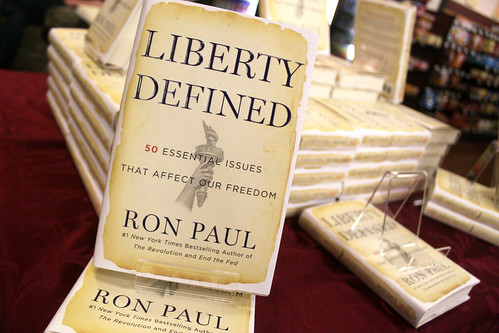
Liberty Defined: 50 Essential Issues That Affect Our Freedom - Ron Paul

And now again something little more modern. In this book Ron Paul defines what freedom is and how to get there. A truly must read for anyone interested in modern libertarianism.


http://rapidshareb.com/downloads/24/32/Liberty_Defined_50_Essential_Issues_That_Affect_Our_Freedom_-_

In Liberty Defined, congressman and #1 New York Times bestselling author Ron Paul returns with his most provocative, comprehensive, and compelling arguments for personal freedom to date. The term “Liberty” is so commonly used in our country that it has become a mere cliché. But do we know what it means? What it promises? How it factors into our daily lives? And most importantly, can we recognize tyranny when it is sold to us disguised as a form of liberty? Dr. Paul writes that to believe in liberty is not to believe in any particular social and economic outcome. It is to trust in the spontaneous order that emerges when the state does not intervene in human volition and human cooperation. It permits people to work out their problems for themselves, build lives for themselves, take risks and accept responsibility for the results, and make their own decisions. It is the seed of America. This is a comprehensive guide to Dr. Paul’s position on fifty of the most important issues of our times, from Abortion to Zionism. Accessible, easy to digest, and fearless in its discussion of controversial topics, LIBERTY DEFINED sheds new light on a word that is losing its shape.

keskiviikko 24. lokakuuta 2012

Hayek on Moral Values & Altruism

Check out this nice little video of FA Hayek. It won't take long, but it will give you a lot. Hayek shows there how morality has never come from Governments but how morality can only come from individuals. There is no such thing as a collective brain.


Reasons You Are a Libertarian (Tom G. Palmer)

And now something little more modern. A lecture by Tom G Palmer.


While the basic tenets of libertarianism — individual liberty, limited government, free markets and peace — seem simple and desirable to a broad swath of society, many people hesitate to identify as libertarian or advocate for libertarian policy proposals. Such reticence often stems from questions about the philosophical, moral, social, or economic justifications behind a liberty-maximizing approach. Can social and economic order emerge when individuals pursue their own interests, or do societies need leaders to govern them? What would happen to social services and infrastructure in a laissez-faire environment? Would culture and prudence dissolve? Would the rich dominate the poor? Cato Senior Fellow Tom G. Palmer discusses these ideas.