Matt Ridley shows how free market creates prosperity for everyone.
torstai 29. marraskuuta 2012

maanantai 19. marraskuuta 2012
Milton Friedman - Why Drugs Should Be Legalized
Milton Friedman eloquently presents why Colorado and Washington made the right choice. No victim. No crime.
maanantai 12. marraskuuta 2012
Human Action: Ludvig Von Mises
Human Action is widely considered Mises' Magnun Opus and it's easy to see why. This book makes truly a case for capitalism.
Human Action is probably the most important book on political economy you will ever own. It was (and remains) the most comprehensive, systematic, forthright, and powerful defense of the economics of liberty ever written.

Read the book
In the foreword to Human Action: A Treatise on Economics, Mises explains complex market phenomena as "the outcomes of countless conscious, purposive actions, choices, and preferences of individuals, each of whom was trying as best as he or she could under the circumstances to attain various wants and ends and to avoid undesired consequences." It is individual choices in response to personal subjective value judgments that ultimately determine market phenomena—supply and demand, prices, the pattern of production, and even profits and losses. Although governments may presume to set "prices," it is individuals who, by their actions and choices through competitive bidding for money, products, and services, actually determine "prices". Thus, Mises presents economics—not as a study of material goods, services, and products—but as a study of human actions. He sees the science of human action, praxeology, as a science of reason and logic, which recognizes a regularity in the sequence and interrelationships among market phenomena. Mises defends the methodology of praxeology against the criticisms of Marxists, socialists, positivists, and mathematical statisticians.
Mises attributes the tremendous technological progress and the consequent increase in wealth and general welfare in the last two centuries to the introduction of liberal government policies based on free-market economic teachings, creating an economic and political environment which permits individuals to pursue their respective goals in freedom and peace. Mises also explains the futility and counter-productiveness of government attempts to regulate, control, and equalize all people's circumstances: "Men are born unequal and ... it is precisely their inequality that generates social cooperation and civilization."
Ludwig von Mises (1881–1973) was the leading spokesman of the Austrian School of Economics throughout most of the twentieth century. He earned his doctorate in law and economics from the University of Vienna in 1906. In 1926, Mises founded the Austrian Institute for Business Cycle Research. From 1909 to 1934, he was an economist for the Vienna Chamber of Commerce. Before the Anschluss, in 1934 Mises left for Geneva, where he was a professor at the Graduate Institute of International Studies until 1940, when he emigrated to New York City. From 1948 to 1969, he was a visiting professor at New York University.
perjantai 2. marraskuuta 2012
Economics in One Lesson - Henry Hazlitt
This book is a truly economics 101. It is an eloquent little book and It`s very hard to name a better introduction for someone who wants to learn about economics and free market capitalism.

Read book
A million copy seller, Henry Hazlitt’s Economics in One Lesson is a classic economic primer. But it is also much more, having become a fundamental influence on modern “libertarian” economics of the type espoused by Ron Paul and others.
Considered among the leading economic thinkers of the “Austrian School,” which includes Carl Menger, Ludwig von Mises, Friedrich (F.A.) Hayek, and others, Henry Hazlitt (1894-1993), was a libertarian philosopher, an economist, and a journalist. He was the founding vice-president of the Foundation for Economic Education and an early editor of The Freeman magazine, an influential libertarian publication. Hazlitt wrote Economics in One Lesson, his seminal work, in 1946. Concise and instructive, it is also deceptively prescient and far-reaching in its efforts to dissemble economic fallacies that are so prevalent they have almost become a new orthodoxy.
Many current economic commentators across the political spectrum have credited Hazlitt with foreseeing the collapse of the global economy which occurred more than 50 years after the initial publication of Economics in One Lesson. Hazlitt’s focus on non-governmental solutions, strong — and strongly reasoned — anti-deficit position, and general emphasis on free markets, economic liberty of individuals, and the dangers of government intervention make Economics in One Lesson, every bit as relevant and valuable today as it has been since publication.
tiistai 30. lokakuuta 2012
What Has Government Done to Our Money? - Murray Rothbard
This is truly a book that every politician should have read. And unfortunately, most of them haven't.

Download the book
The book made huge theoretical advances. He was the first to prove that the government, and only the government, can destroy money on a mass scale, and he showed exactly how they go about this dirty deed. But just as importantly, it is beautifully written. He tells a thrilling story because he loves the subject so much.
The passion that Murray feels for the topic comes through in the prose and transfers to the reader. Readers become excited about the subject, and tell others. Students tell professors. Some, like the great Ron Paul of Texas, have even run for political office after having read it.
Rothbard shows precisely how banks create money out of thin air and how the central bank, backed by government power, allows them to get away with it. He shows how exchange rates and interest rates would work in a true free market. When it comes to describing the end of the gold standard, he is not content to describe the big trends. He names names and ferrets out all the interest groups involved.
Since Rothbard's death, scholars have worked to assess his legacy, and many of them agree that this little book is one of his most important. Though it has sometimes been inauspiciously packaged and is surprisingly short, its argument took huge strides toward explaining that it is impossible to understand public affairs in our time without understanding money and its destruction.
sunnuntai 28. lokakuuta 2012
Ayn Rand - Liberty vs Socialism
In this little video clip Ayn Rand explains how liberty and capitalism are fundamentally inseparable. If you still haven't read Atlas Shrugged I truly encourage you to download the ebook from my previous post.
perjantai 26. lokakuuta 2012
Atlas Shrugged - Ayn Rand
Who is John Galt?

Ayn Rand`s Atlas Shrugged is first work of fiction in our archives and that`s for a reason. This magnum opus is something that everyone should have read.
http://extabit.com/file/28y4e6wioz2f0
This is the story of a man who said that he would stop the motor of the world—and did. Was he a destroyer or the greatest of liberators? Why did he have to fight his battle, not against his enemies, but against those who needed him most, and his hardest battle against the woman he loved? What is the world’s motor—and the motive power of every man? You will know the answer to these questions when you discover the reason behind the baffling events that play havoc with the lives of the characters in this story.
Tremendous in its scope, this novel presents an astounding panorama of human life—from the productive genius who becomes a worthless playboy—to the great steel industrialist who does not know that he is working for his own destruction—to the philosopher who becomes a pirate—to the composer who gives up his career on the night of his triumph—to the woman who runs a transcontinental railroad—to the lowest track worker in her Terminal tunnels.
You must be prepared, when you read this novel, to check every premise at the root of your convictions. This is a mystery story, not about the murder—and rebirth—of man’s spirit. It is a philosophical revolution, told in the form of an action thriller of violent events, a ruthlessly brilliant plot structure and an irresistible suspense. Do you say this is impossible? Well, that is the first of your premises to check.
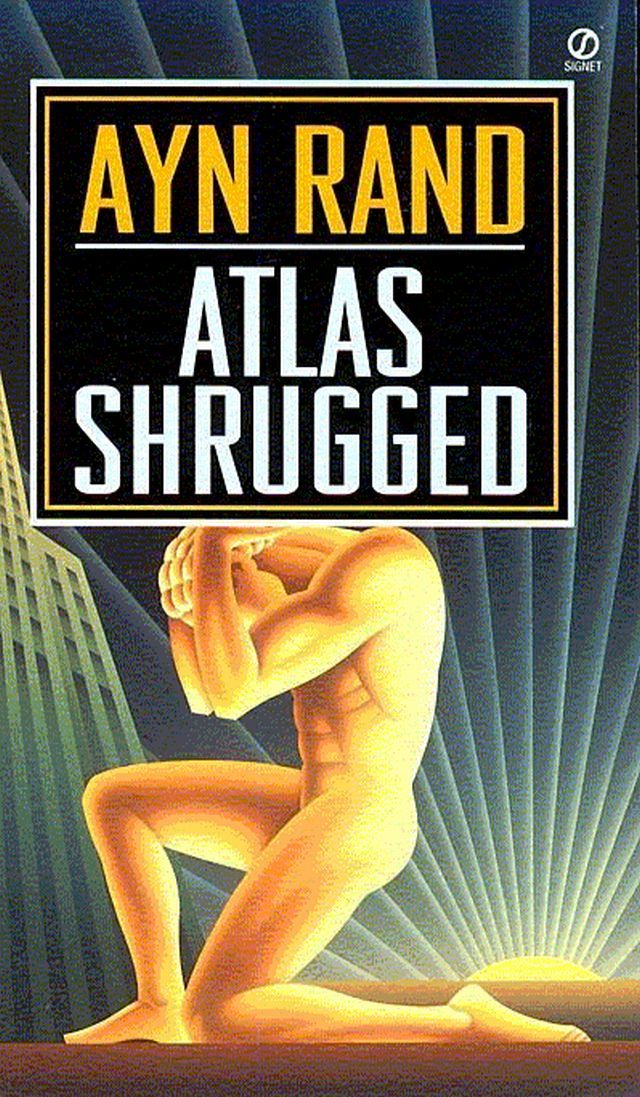
Ayn Rand`s Atlas Shrugged is first work of fiction in our archives and that`s for a reason. This magnum opus is something that everyone should have read.
http://extabit.com/file/28y4e6wioz2f0
This is the story of a man who said that he would stop the motor of the world—and did. Was he a destroyer or the greatest of liberators? Why did he have to fight his battle, not against his enemies, but against those who needed him most, and his hardest battle against the woman he loved? What is the world’s motor—and the motive power of every man? You will know the answer to these questions when you discover the reason behind the baffling events that play havoc with the lives of the characters in this story.
Tremendous in its scope, this novel presents an astounding panorama of human life—from the productive genius who becomes a worthless playboy—to the great steel industrialist who does not know that he is working for his own destruction—to the philosopher who becomes a pirate—to the composer who gives up his career on the night of his triumph—to the woman who runs a transcontinental railroad—to the lowest track worker in her Terminal tunnels.
You must be prepared, when you read this novel, to check every premise at the root of your convictions. This is a mystery story, not about the murder—and rebirth—of man’s spirit. It is a philosophical revolution, told in the form of an action thriller of violent events, a ruthlessly brilliant plot structure and an irresistible suspense. Do you say this is impossible? Well, that is the first of your premises to check.
Tilaa:
Blogitekstit (Atom)